Why consistency matters, discipline as opportunity
Qi Gong is not something you do once. It’s something you build, day after day.
The word Qi Gong is often translated as “energy work” but that translation doesn’t quite hold its depth. Qi Gong is not a technique, and it’s not simply a form of gentle exercise. It is a language of the body, a way of listening, a practice that has accompanied human beings for thousands of years.
Long before it became associated with martial arts, Qi Gong emerged as a practice for health and longevity. Its roots go back more than 4,000 years, even though the term itself appeared much later in Taoist scriptures. Originally, it wasn’t something you “did” for a set amount of time. It was something you lived, something woven into daily life.
Tai Chi, which is widely known today, is actually a descendant of Qi Gong. Within each posture, each slow movement, each seemingly simple gesture, something much deeper is taking place. The body is engaged on multiple levels at once, muscular, nervous, energetic, emotional.
Through the conscious movement of the arms, the torso, the spine, Qi Gong works along the meridians, the energetic pathways described in Chinese medicine. Fluids begin to circulate more freely. Oxygenation increases. Tension starts to dissolve.
When energy is no longer stagnant, the body begins to produce its own internal medicine. The chemistry of wellbeing does not come from outside of us, it arises from within.
We are living in a time of contraction. The body tightens, the breath becomes shallow, the mind moves faster and faster. Qi Gong offers a response that is both simple and radical, a return to inhabiting the body, with gentleness and with continuity.
Slow movement helps rebalance the two hemispheres of the brain. Instead of overtraining one side, as happens in many activities, the organism returns to a more natural symmetry.
Over time, this balance begins to show. In posture. In the gaze. In the way we move through the world. The smile comes back. The chest softens and opens. The breath becomes fuller.
But a practice of this depth cannot truly be transmitted through instructions alone.
It is passed on through a living lineage.
On practice, discipline, and opportunity
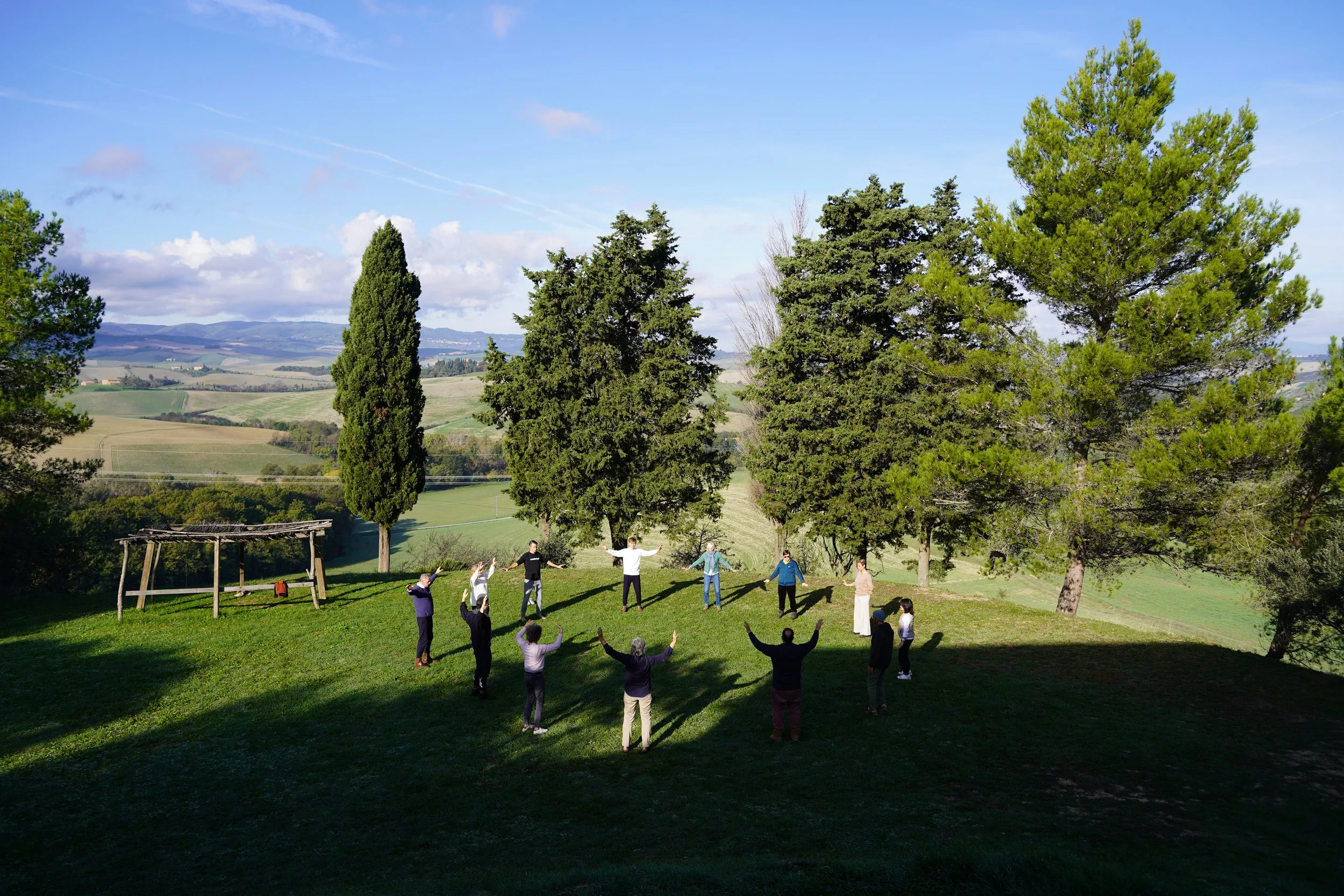
At the school, during the residential programme, this practice is offered every day. Not as something mandatory, but as an opportunity.
You can choose to come, or not. You can choose to sleep longer. There is no imposition. But there is also a deeper invitation.
Because this is not a practice that reveals itself through occasional contact. It builds over time. Some students, after a few weeks of consistent practice, begin to accumulate a kind of energy that is tangible, something that can be felt in the body, in presence, in the way they move and relate.
And this is where the value becomes clear.
What is being shared is not just a set of movements. It is a transmission, a gift that comes through a lineage of teachers who have dedicated their lives to this practice.
Hanako speaks about this with humility. The teachings she received were given to her because she showed up, consistently, with respect and dedication. And in the same way, what is offered here is not something she claims as her own, but something she passes on.
A practice that stays with you
There is also something very practical in this.
In everyday life, outside of a space like The Transmission School, it is not always easy to find a teacher. And even when you do, it may require time, travel, and resources, often for just one or two classes a week.
Here, there is a window.
A period of time where the practice is available daily, where it can become part of your habits.
A way to build something that you can carry with you.
Over time, this consistency reflects back in simple, tangible ways.
The body feels stronger, yet more relaxed.
There is more flexibility, less pain.
A different relationship with aging, with energy, with presence.