
The History
We came together as a community after having learned from different elders, traditions and cultures, wanting to take care of a piece of Pacha Mama (Mother Earth in Quechua) in a different way. As members of an intentional eco-community, we were able to experiment and learn. We founded a Nature School with Montessori and Waldorf trained teachers for children up to 14 years, which was the first of its kind in Italy. It became a big success and many schools came to us for training and inspiration. We taught people of all ages about alternative living, schooling and medicine.
We could witness the true power of people young at heart who are taught happiness, consciousness and freedom in a responsible way. That is why we believe that the right setting, with the best teachers and total trust in one another one, we can make the difference in people’s life, as well as ours.
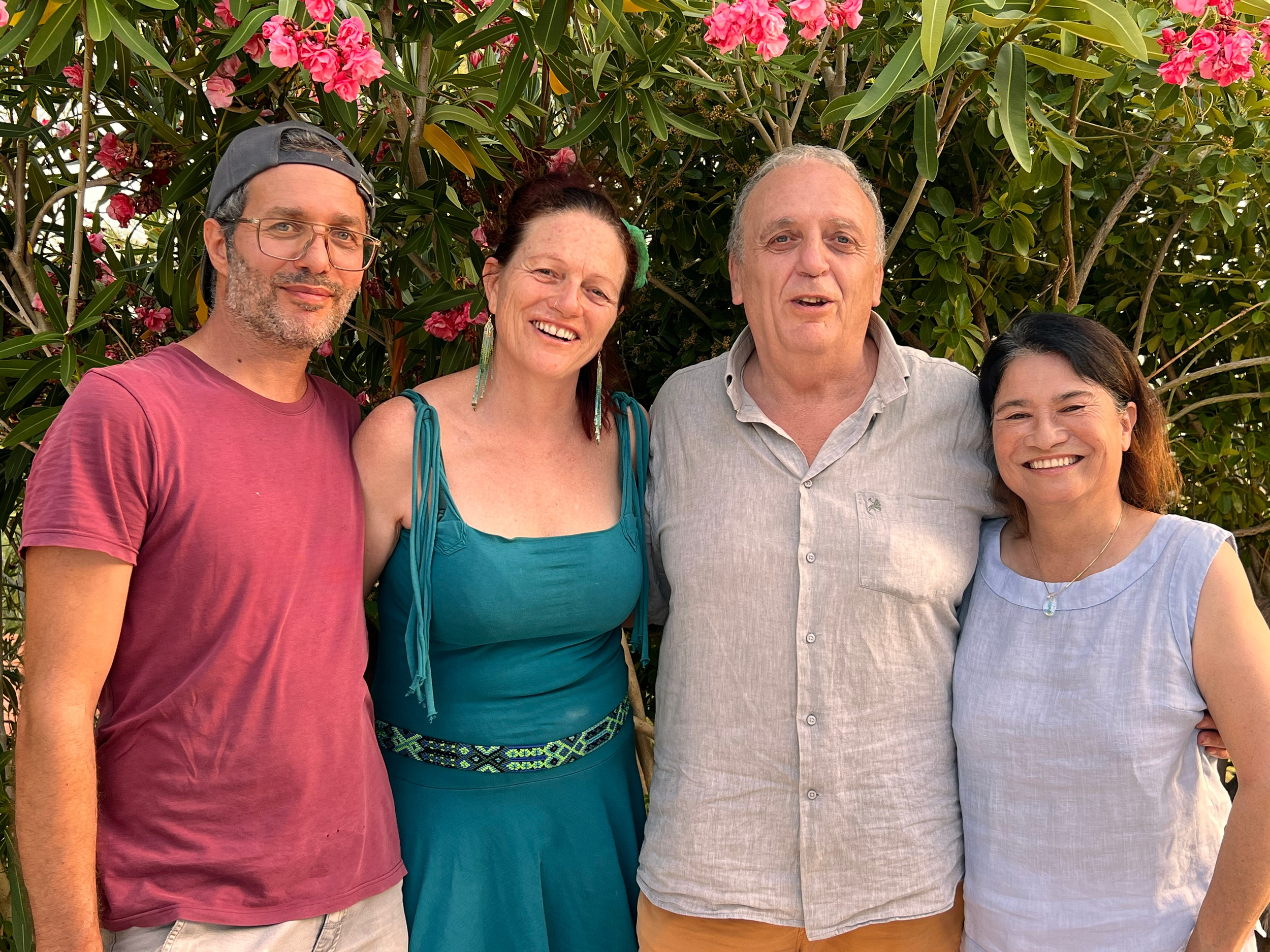
The Founders, Our Story:
The Transmission School was not founded on a particular day. There was no moment when four people sat around a table, wrote down a plan and decided to build a school.
It came together much more slowly than that, through years of living, working, friendship and change. One project led to another. People met, some stayed and some moved on. There were periods when everything seemed possible and others when it seemed that nothing could be saved. And through all of this, four people kept finding their way back to one another: Pushpa, Vito, Fabrizio and Hanako.
So, the Transmission School did not begin with the idea of starting a school. However, it began with a vision Pushpa had been carrying since she was nineteen: to create a place where people could learn through direct experience, where education could live alongside community, evolving and a relationship with the Earth, and where knowledge could be passed on by people who had actually lived it.
For many years, that vision took the form of community life. Pushpa and Vito were learning, in practice, what it meant to create a place where people could live and grow together, work with the land and take responsibility for what their presence created around them.
For Vito, this was more than keeping a community functioning. He understood that a place is shaped by the people who inhabit it: by how they relate to the land, to one another and to the space they share. A place becomes alive when the people within it become aware of their part in creating it. It was in this spirit that they began inviting different people into the life of the community, looking for practices and ways of seeing that could help them understand more deeply what was happening between people.
One of those people was Fabrizio. He was invited to work with the community through family constellations. He brought a different kind of vision: an ability to see the invisible patterns within relationships and groups, the loyalties and dynamics that can quietly shape how people live together. The work was not simply about solving a problem or giving people an answer. It revealed another way of learning: by looking at what is actually happening between us, and allowing that to teach us.
Life kept providing its turns, and Hanako entered the story at a moment when the community that Pushpa and Vito had built was reaching the end of its journey. She could sense what it was holding, what had become difficult, and what was no longer possible. The previous project eventually came to an end, but her encounter with Pushpa and Vito did not.
Instead, Hanako began travelling between Amsterdam and Italy, returning again and again. She was drawn not only to the place, but to the people and to the possibility of creating something together. And slowly became part of something that did not yet have a name. There was no school yet, only a group of people, a shared history and the feeling that something new was trying to emerge.
Hanako brought a quality of perception that was unlike the others'. She paid attention to the body, to the land, to the qualities of a place and to things that can be felt long before they can be explained. Through her presence, the emerging project began to be seen not only as a community, but as a place of learning.
It was during those years, through conversations between Pushpa and Hanako, that the idea of a school began to become clearer. They started to ask what would happen if the knowledge they had gathered through years of living, working, teaching and learning could be brought together in one place, and if other people who had something deeply lived to transmit could become part of it.
And perhaps this is the most important part of this unique story: the four founders did not have the same background. They did not teach the same things. They did not arrive with one shared method. They arrived with different gifts.
Pushpa carried a vision of education that had been with her since she was young: learning as something that draws out what is already possible within a person, and a belief that human development cannot be separated from our relationship with life itself.
Vito understood how to create and sustain community, and how the people who inhabit a place become responsible for what that place can become.
Fabrizio understood the hidden architecture of relationships: the patterns that connect us, influence us and sometimes prevent us from seeing what is really happening.
Hanako brought another way of seeing altogether — through the body, the land and the subtle qualities of a place.
None of these things, on its own, was The Transmission School.
Together, they were the beginning of it.
The school emerged from the recognition that these ways of knowing did not need to be kept apart. They could meet in one place, alongside practical skills, inner development, relationships, the body, the land and the many different ways human beings have learned to understand the world.
The place itself came later.
Pushpa had remained in contact for years with the Swiss owners of the property. They had come to know her, Vito and the people around them, and had seen how they lived and cared for the places they inhabited. When they eventually offered the property to the project, it came through a relationship of trust that had grown over time.
By then, much of what would become The Transmission School was already there: in the people, in their relationships, in the knowledge they carried and in the years of experience that had brought them to this point.
What they created was not a school built around one person's philosophy. It was a place born from the meeting of four very different ways of seeing.
And perhaps that is why it could become what it is today: a place where people come from different backgrounds and lineages, encounter teachers from different traditions, and where something new can emerge from that meeting.
The Transmission School continues to grow in the same way it began — through people who have something real to pass on, not from the desire to create another institution.
That is the transmission.