
There Is No Such Thing as a Weed
This reflection was born during Seeds for a Resilient Future, a one-day gathering that took place at a neighboring farm of The Transmission School, Floriddia.
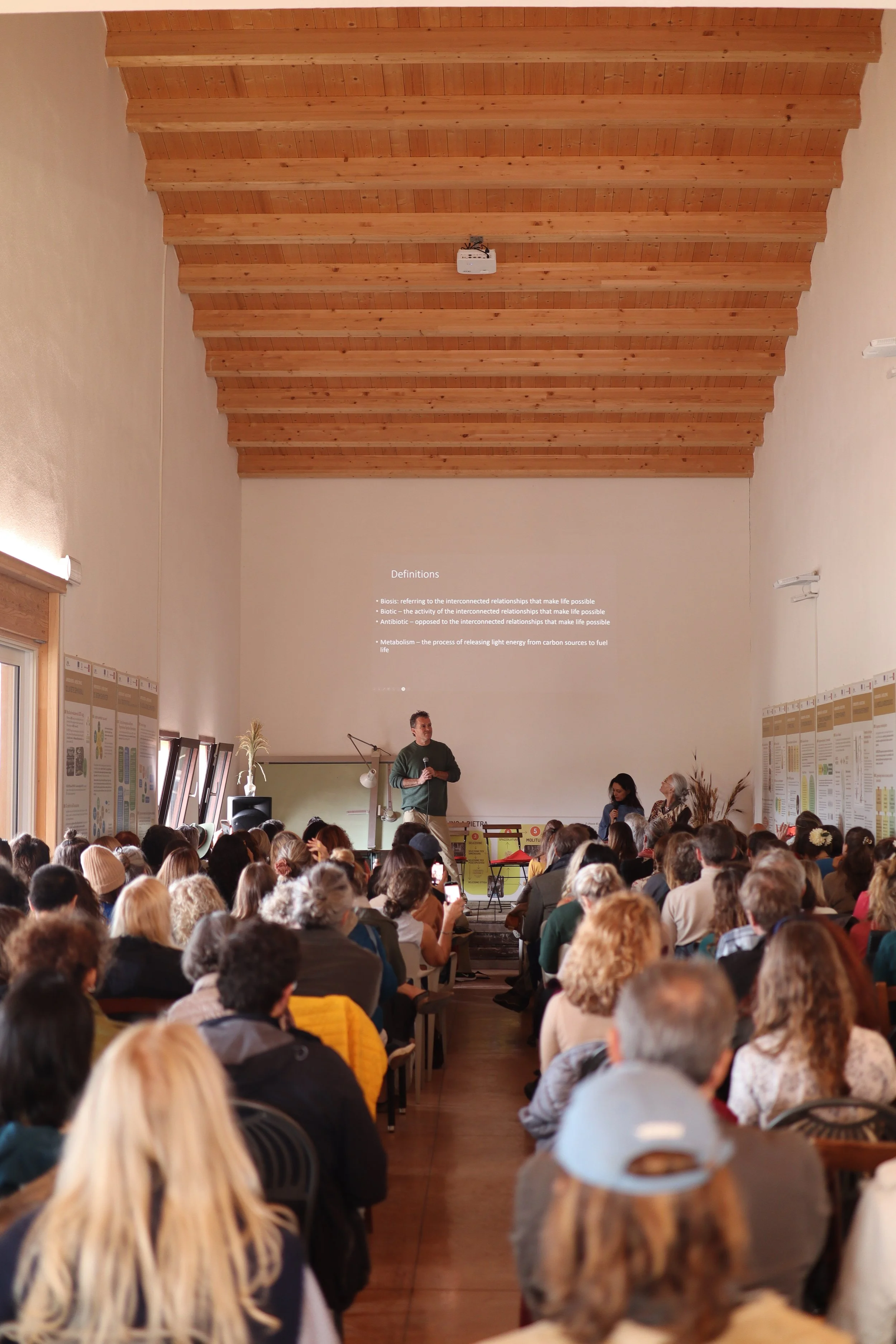
The room was full, attentive, and quiet in that particular way that emerges when people sense that something deeper than information is being transmitted.
On that day, Zach Bush was lecturing on his research as a former cancer researcher, speaking about the links between glyphosate and the dramatic rise of autoimmune diseases and cancer. His words moved fluidly between science, ecology, and lived experience, touching something that felt both urgent and intimate.
Then a question from the field.
The question came from Jouko Kivimetsä, an expert in edible wild plants and a man deeply attuned to landscapes and ecosystems.
Jouko spoke about farmers. About how much they love their soil, and how deeply they struggle with weeds.
Not because they want to poison the land, most of them do not. But because weeds have been framed as the enemy. Something to be eliminated. Something that steals nutrients, reduces yields, and threatens productivity.
Many farmers feel trapped inside this narrative. If they do not fight the weeds, they fear they will fail. And yet, fighting them often means participating in systems that slowly destroy the very soil they love.
So the question was simple and radical at the same time.
How do we work with weeds without seeing them as a problem to eradicate?
The answer that followed landed in the room with unusual clarity.
There is no such thing as a weed.
After the lecture, the land speaks
After the talk, we visited the farm.
Not a futuristic experiment. Not a showcase of innovation. But a place rooted in agricultural methods from the 1950s. The kind of farm that feels almost forgotten.
Here, bread and pasta are produced in a way that tells a different story about food. What struck many of us was that even people who usually experience gluten intolerance could eat these foods without symptoms.
As Zach Bush often suggests, what many people identify as gluten intolerance may in fact be an intolerance to glyphosate, a chemical so deeply embedded in modern agriculture that it has quietly reshaped our relationship with food, soil, and health.
But again, the most powerful teaching did not come from data or statistics. It came from observing the land itself.
Symptoms, not enemies
What we call weeds are not attackers. They are symptoms.
Weeds appear where the soil is deficient in nutrients. They are nature’s response to imbalance, not its cause. Their role is to restore what is missing, to bring minerals back to the surface, to repair what has been exhausted.
When farmers leave weeds in place for two or three years, something unexpected happens. The soil begins to heal. Nutrients return. The ecosystem reorganizes itself.
The pattern is unmistakable.
Cancer is not the problem. Diabetes is not the problem. Autoimmune disease is not the problem. These are symptoms of declining biosis, of a breakdown in metabolic and relational balance.
Yet our dominant story insists on war.
We fight disease.
We fight carbon dioxide.
We fight viruses.
We fight weeds.
We love stories in which something outside of us is attacking, because those stories justify control, intervention, and violence. They promise that if we eliminate the enemy, things will get better.
But life does not work that way.
Remembering how to farm
The farm we visited offers a living example of another path.
They stopped spraying chemicals. They still plow for now, but the next step is to stop plowing and begin seed drilling instead. To manage weeds and cover crops, they plan to reintroduce animals.
Grazing animals were removed from most farms about fifty years ago. Their return changes everything.
Regenerative farmers who stay on this path for five to ten years begin planting many species that are not cash crops. These are called cover crops, and they exist purely to feed the soil.
In some places, farmers now use seed mixes of thirty different species, clovers, peas, vetch, grasses, flowers, growing between crops, between seasons, even between rows.
The goal is simple.
Never leave bare earth.
Always more species.
More diversity.
More life.
When animals are rotated quickly across the land, cattle, sheep, chickens moving in rhythm with the ecosystem, it becomes possible to rebuild extraordinary amounts of topsoil. A meter of fertile soil can be regenerated over ten to twenty years.
This is not a technique.
It is a remembering.
From soil to society
At a certain point, it becomes impossible not to notice that this story is not only about farming.
The same mindset that labels plants as weeds also shapes how we see viruses, people, ideas, and emotions. We decide that something is unwanted, inconvenient, draining, or dangerous, and we try to remove it.
Very often, the people closest to us become our weeds. Parents, children, partners, colleagues. Instead of seeing them as part of our biotic environment, part of the ecosystem that is shaping us, we experience them as something that is taking energy away.
Even conscious communities fall into this trap. In the attempt to become more aware, more evolved, more aligned, there is a tendency to sterilize the environment. To surround ourselves only with people who think like us, speak like us, see the world as we do.
At first, this feels safe.
Then something strange happens.
When the only identity we have is being against something, against the unconscious, against the system, against the other, and that other disappears, we lose our reference point. The identity collapses. Panic sets in. And suddenly, the threat seems to come from everywhere.
This is how communities fracture.
This is how relationships break.
This is how we end up destroying what we once loved.
An invitation to radical responsibility
Regenerative agriculture teaches through experience. Observation followed by adaptation. Again and again.
Our education systems have largely failed to teach this way. So now, farmers, physicians, educators, engineers, and all of us are being invited back into experiential learning.
But none of this can truly change until we take radical responsibility for the things we have labeled as weeds in our own lives.
What if the discomfort you are experiencing is not an enemy, but a signal of something missing?
What if the person who triggers you is not draining you, but inviting you to widen your capacity for connection?
What if consciousness is not about eliminating fear, guilt, or shame, but about expanding our aperture until we can feel them alongside joy, love, and presence?
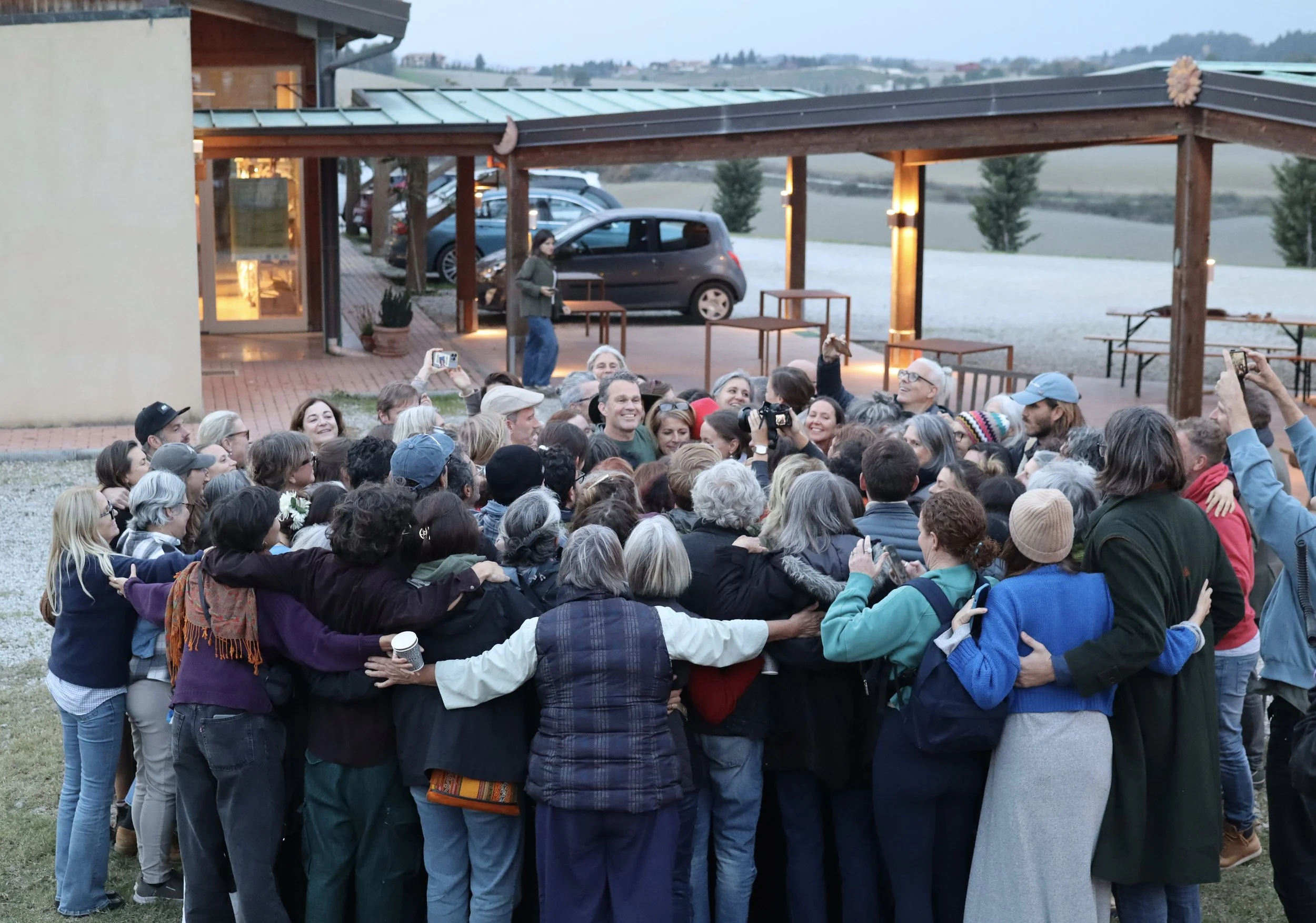
To be a conscious species may require something far more demanding than purity or agreement.
It may require the courage to remain open, even when the system feels messy, uncomfortable, and alive.
Just like a healthy field.
Watch the short clip on YouTube from which this extract is taken.
Full credit to Zach Bush MD and Jouko Kivimetsä for the question and the editing.